Causal Directed Acyclic Graph (DAG)
A non-parametric encoding of the assumed causal relationships among exposure, outcome, confounders, mediators, and colliders — the figure that justifies which variables to adjust for.
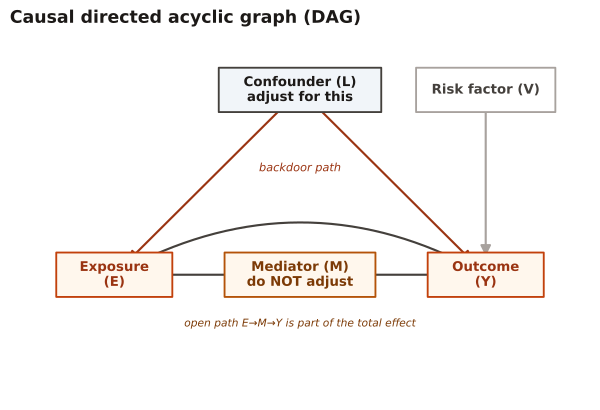
At the design stage, before choosing covariates. The DAG makes the backdoor criterion operational: adjust for confounders that open exposure–outcome backdoor paths; do NOT adjust for mediators or colliders, which would induce bias.
Arrows are direct causal effects; a path is 'open' unless blocked. A confounder (L) with arrows into both E and Y opens a backdoor path you must close; a mediator (M) on E→Y is part of the effect — conditioning on it removes the indirect effect or opens a collider path.
A study of a drug (E) on an outcome (Y) where comorbidity burden (L) drives both treatment choice and the outcome, on-treatment blood pressure (M) mediates part of the effect, and an unrelated risk factor (V) affects Y. The DAG encodes which to adjust for.
Result: The backdoor path E←L→Y is closed by adjusting for L; M is left unadjusted (conditioning on it would block the indirect effect and could open a collider path); V need not be adjusted for confounding but improves precision. The minimal sufficient adjustment set is {L}.
Reference: Gatto NM, Wang SV, Murk W, et al. Visualizations throughout pharmacoepidemiology study planning, implementation, and reporting. Pharmacoepidemiol Drug Saf. 2022;31(11):1140-1152.