Treatment-Pathway Sunburst
A radial alternative to the Sankey: concentric rings encode successive lines of therapy, with wedge angle proportional to the share of patients on each path.
To summarize sequential treatment shares when the hierarchy (1L → 2L → 3L) is the focus and you want a compact, single-glance overview. Prefer the Sankey when flows between specific therapies (who switches to what) matter more than nested proportions.
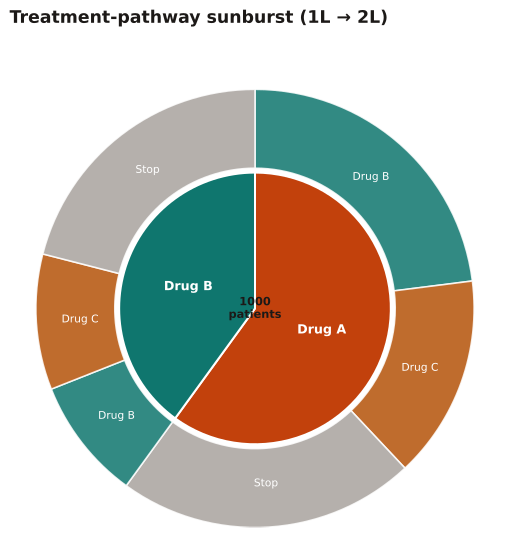
The inner ring is first line; each outer ring subdivides its parent by what came next. Wedge angle is patient share; reading outward traces the most common pathways. Thin wedges are rare paths — label only the ones large enough to read.
1000 patients start first-line (600 Drug A, 400 Drug B); the outer ring splits each first-line group by its second-line therapy (switch, stay, or stop), with wedge angle proportional to patient count.
Result: The inner ring is 60% Drug A / 40% Drug B; reading outward, the largest single pathway is Drug A → Drug B (230/1000 = 23%), and 430/1000 (43%) reach 'Stop' by second line — the same totals as the Sankey, shown as nested proportions.
Reference: Gatto NM, Wang SV, Murk W, et al. Visualizations throughout pharmacoepidemiology study planning, implementation, and reporting. Pharmacoepidemiol Drug Saf. 2022;31(11):1140-1152.