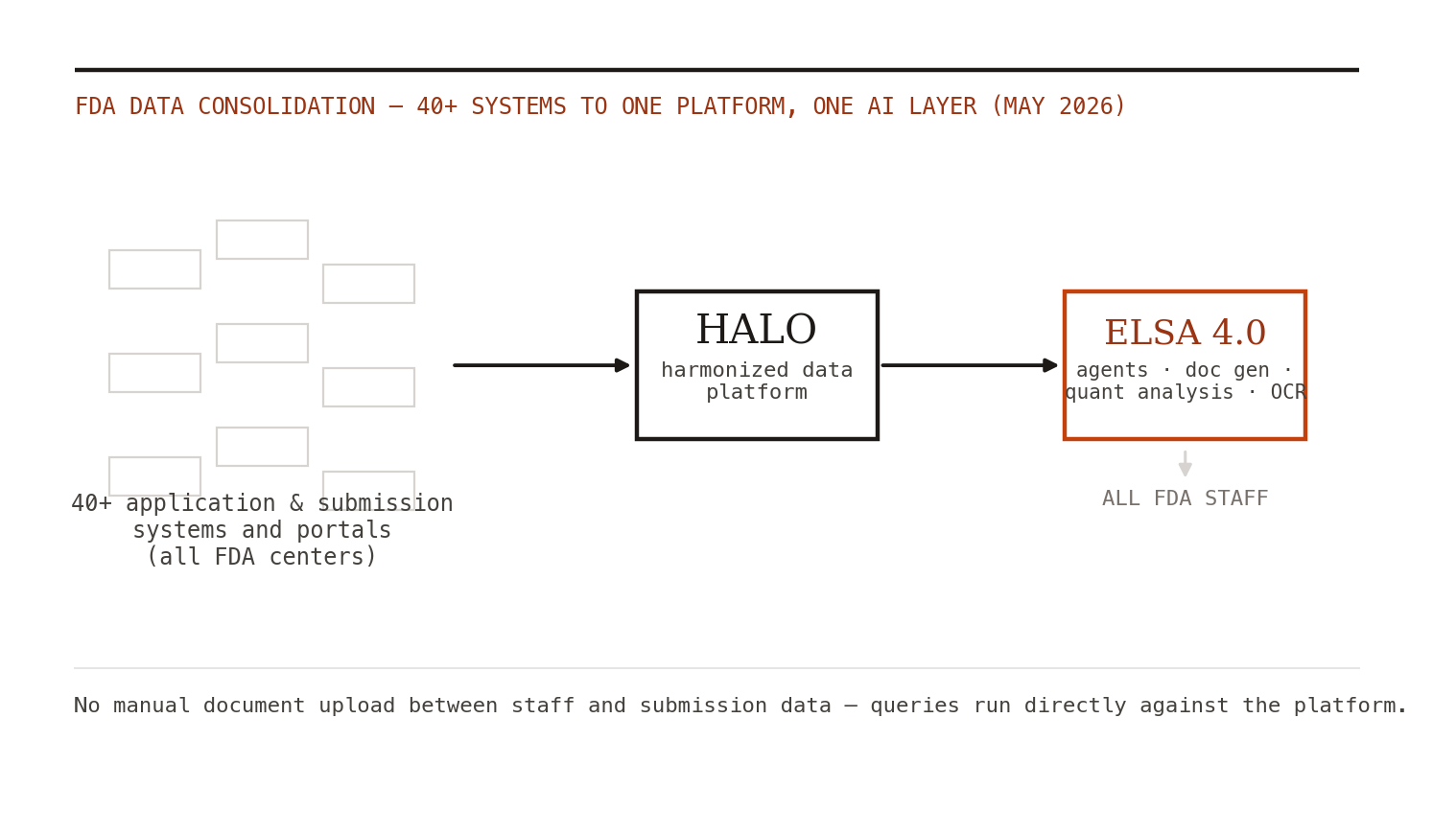
While most of the industry was still debating AI governance frameworks in conference rooms, the regulator went ahead and shipped. On May 6, 2026, the FDA released Elsa 4.0, the fourth major version of its internal generative AI system, now available to all agency staff — reviewers, investigators, the lot.[1,2] The feature list reads like a mature enterprise AI product because it is one: custom agents, document generation, quantitative data analysis and visualization, OCR, voice dictation, secure web search, and optimized retrieval across large document repositories.[2,3]
Regulatory caveat: this is an interpretation of public FDA and legal-industry reporting, not a prediction of how any specific review or inspection will proceed. Sponsors should verify current agency guidance, submission standards, and program-specific communications before changing a live regulatory strategy.
The quieter announcement is the bigger one. The agency completed consolidation of more than 40 separate application and submission data sources, systems, and portals — across all FDA centers — into a single platform called HALO (Harmonized AI & Lifecycle Operations for Data), and began wiring HALO directly into Elsa so staff can query submission data and build workflows without manually uploading documents.[1,2] Anyone who has done enterprise data work knows which of those two announcements was harder. Forty-plus legacy systems into one platform is the kind of project that eats CIOs; the FDA appears to have actually done it.
And it is being operationalized at the sharp end: an inspection pilot launched in April 2026 has completed over 40 AI-assisted one-day inspections, most resulting in No Action Indicated classifications.[3,4] Sidley's review of Elsa's first eleven months calls it what it is — a new oversight paradigm, not a productivity tool.[4]
What this means if you make evidence for a living
I want to push past the obvious take ("FDA uses AI, neat") to the operational consequences for people who build regulatory evidence packages, including RWE submissions.
Your submission is now an input to a machine. When a reviewer's first pass is Elsa querying HALO, the de facto standard for submissions shifts toward machine-legibility: consistent terminology, clean tables, explicit data provenance, internal cross-references that resolve. A beautifully argued narrative with inconsistent numbers across modules used to cost you reviewer goodwill. Now it costs you whatever the model flags it as — and you will not be in the room when it does. The dumb, unglamorous discipline of consistency just acquired regulatory teeth.
Asymmetry is closing. Sponsors have long enjoyed an information-processing advantage: armies of regulatory affairs people who know the dossier cold, versus time-constrained reviewers. An agency that can interrogate the entire submission corpus in seconds — plus its own historical decisions across centers — flips that. Expect more pointed information requests, sooner, referencing things you said in other submissions. The era of quietly inconsistent positions across programs is ending.
RWE scrutiny gets cheaper for the agency. The expensive part of auditing a real-world evidence study — tracing definitions, checking cohort logic against the protocol, comparing what you pre-specified to what you reported — is exactly the kind of cross-document consistency checking LLM systems do well. If your RWE shop's quality bar relied partly on the assumption that nobody would actually check everything: someone checks everything now, and it bills zero hours.
The honest caveats
Elsa's outputs are only as good as its validation, and the agency has been appropriately cagey about error rates; an NAI-heavy one-day inspection pilot could reflect risk-based targeting of likely-clean sites rather than AI brilliance.[4] Federal AI deployments have a long history of demo-to-production decay. And there is a real institutional risk in regulator-grade automation: a false sense of comprehensiveness. Reading everything is not the same as understanding anything — a lesson our field learned from claims data decades ago.
But directionally, this is settled. The FDA spent 2025 building the plumbing and is spending 2026 turning on the appliances. Sponsors who still treat AI-readiness as a competitive differentiator have it backwards — it is now table stakes set by the other side of the table.