One of the cleaner signals from ISPOR 2026: real-world evidence is no longer a US-and-Nordics story. RWE use is expanding across the entire product lifecycle and across regions, with China emerging as a major producer of real-world studies — and, in the same breath, with Western payers and HTA bodies expressing structural reservations about accepting that evidence, citing governance and data comparability concerns.[1]
I want to take the skepticism seriously rather than diplomatically, because it contains a real methods problem — and also a double standard worth naming.
What the skepticism is actually about
When a European HTA assessor hesitates over a Chinese hospital-registry study, the stated concerns are rarely about analysis. They are about everything upstream of analysis: Was the protocol pre-specified or written after the results? What governs data access, and could the sponsor see outcomes before designing the study? How were the data generated — by what coding incentives, what care patterns, what documentation culture? Can anyone outside the system audit any of it?
These are legitimate questions. They are also — and here is the uncomfortable part — exactly the questions one should ask about a US claims study, where coding reflects billing incentives, formulary design steers channeling, and "data governance" sometimes means a license agreement and a prayer. The difference is familiarity, not virtue. Western assessors have calibrated priors for Optum and CPRD artifacts; they have no priors for a provincial Chinese EHR network, so the default is distrust. Rational, but not principled.
The missing infrastructure is trust, made checkable
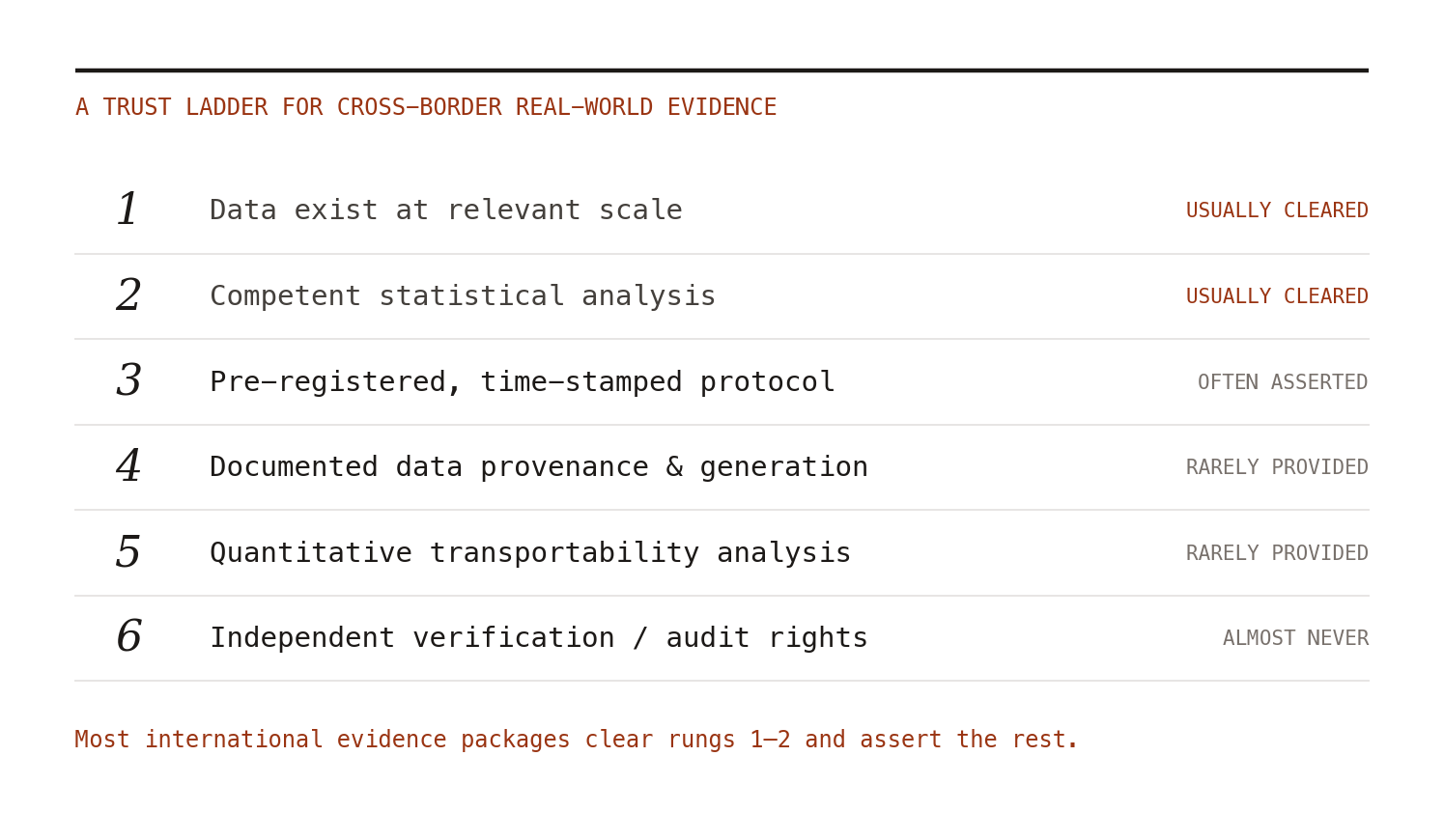
The field's instinct is to respond with statistics — sensitivity analyses, calibration exercises. Necessary, insufficient. Cross-border evidence fails on provenance, and provenance needs infrastructure, not eloquence. The components already exist; they have simply not been assembled into an expectation:
Pre-registered protocols with time-stamped amendments — the HARPER template exists precisely so a study's design can be inspected independent of its results.[2] Data provenance documentation that describes generation mechanisms (who codes what, when, under what incentive) rather than just variable lists — the demand for "decision-grade" RWE standards, a running theme of ISPOR's RWE Transparency Initiative, is this same idea wearing a policy hat.[3] Transportability analysis as a first-class deliverable: if the clinical question is "what would this effect be in our population," methods for transporting estimates across populations exist and have for years — the scandal is how rarely an international dossier actually deploys them quantitatively rather than waving at "differences in patient populations" in a limitations paragraph. And independent verification rights — sampled re-analysis, federated queries, audit access — which is where most cross-border arrangements currently fall down hardest.
Stack those and you get something like a trust ladder. Most international RWE packages today clear "data exist" and "analysis is competent" and assert the rest. The producers — Chinese, American, anyone — who climb the remaining rungs voluntarily will find the acceptance question dissolving on its own.
Why this matters strategically
Two reasons to care now. First, the JCA era multiplies the value of evidence that travels: a PICO frame consolidated across 27 member states is precisely the setting where a transportable, provenance-documented study beats three local ad-hoc ones.[4] Second, the volume asymmetry is brutal: health systems covering hundreds of millions of patients are coming online as evidence producers. Pretending that evidence can be ignored indefinitely is not a strategy; building the verification infrastructure to engage with it on rigorous terms is.
The first regulator or HTA body that publishes an explicit, criterion-based framework for foreign-RWD acceptability — rather than ad-hoc case-by-case hedging — will set the global standard and harvest the evidence surplus. My money is on it happening before 2028. The methods community should be writing that framework now, while it can still be written by methodologists instead of trade negotiators.