Every few weeks a student or early-career analyst asks me some version of: should I be worried? The honest answer is yes — but about the wrong thing, and the labor-market data explain why.
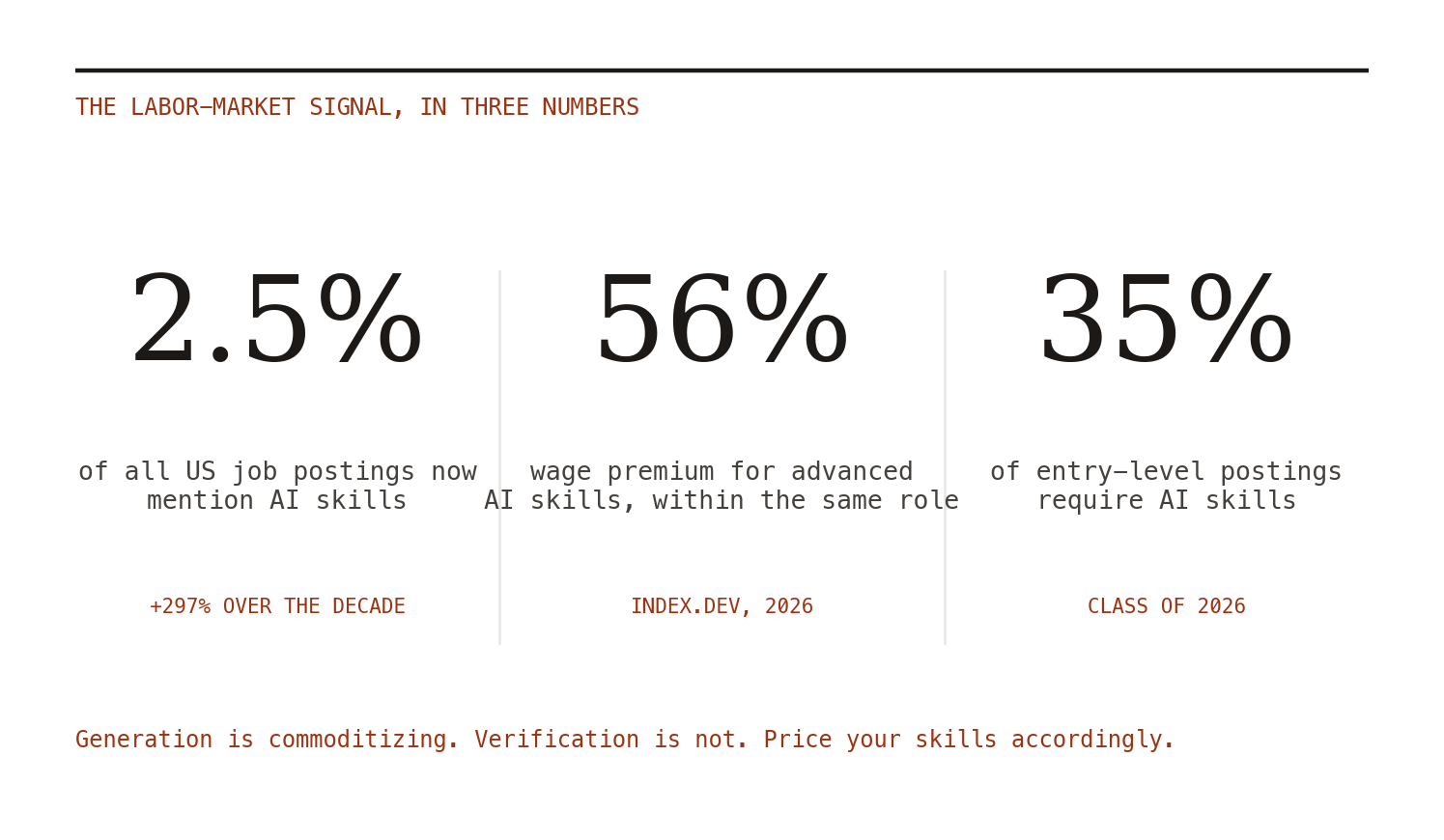
The numbers first, because this is an evidence desk. AI-related skills now appear in 2.5% of all US job postings — a 297% increase over the past decade — and demand for AI fluency is growing roughly 20 times faster than the overall job market.[1] Workers with advanced AI skills earn a reported 56% more than peers in the same roles without them.[2] At the entry level, about 35% of postings now require AI skills, and two-thirds of employers say they plan to hire for them — while 40% simultaneously anticipate reducing headcount where AI agents can absorb tasks.[3,4] That last pairing is the entire story in one sentence: the same employers are hiring AI-fluent people and shrinking AI-replaceable functions.
So yes, worry. But here is where I think the standard advice — "learn to prompt," take an AI certificate, sprinkle 'LLM' on the résumé — misses what is specific about our field.
HEOR's automation profile is unusual
Think about what an HEOR/RWE analyst actually produces: literature syntheses, cohort analyses, economic models, dossiers. Over the past year, credible evaluations have shown LLM systems matching or beating human performance on big chunks of that stack — screening, extraction, even end-to-end review drafting.[5] The production of analysis is commoditizing fast. If your value proposition is "I can run the model / write the SAS / build the Markov," you are competing with software on price, and you will lose.
But notice what did not get automated: deciding whether the analysis answers the decision-maker's question. Whether time zero is right. Whether the comparator is the one a payer will actually demand. Whether the extraction error rate is tolerable for this submission. Every one of those is a judgment task sitting on top of methods training — and the supply of people who can do them is, if anything, shrinking relative to the flood of machine-generated analysis that needs judging. The bottleneck has moved from generation to verification, and verification pays the premium.
What to actually do, by career stage
Students: do not skip the boring fundamentals on the theory that AI makes them obsolete — the fundamentals are precisely what verification runs on. You cannot check an agent's propensity-score workflow if you have never built one yourself, painfully. Use AI constantly, but use it the way a flight instructor uses a simulator: as reps, with you grading the landing.
Early-career analysts: your differentiator for the next five years is being the person who can drive agentic workflows and audit them — design the validation sample, set the error tolerance, sign your name. "I produced this with AI assistance and here is my verification protocol" is a sentence that will get you promoted. "AI did it" and "I don't use AI" are both sentences that will not.
Leaders: you are about to manage portfolios where machine output volume grows 10x while your headcount does not. The roles to create now are review architects and validation leads — and the people to grow into them are your methodologists, not your prompt enthusiasts.
The 56% premium is real, but read it correctly: it is not a bounty for AI usage. It is the market repricing scarce judgment in a world of abundant generation. HEOR happens to train judgment for a living. Act like it.