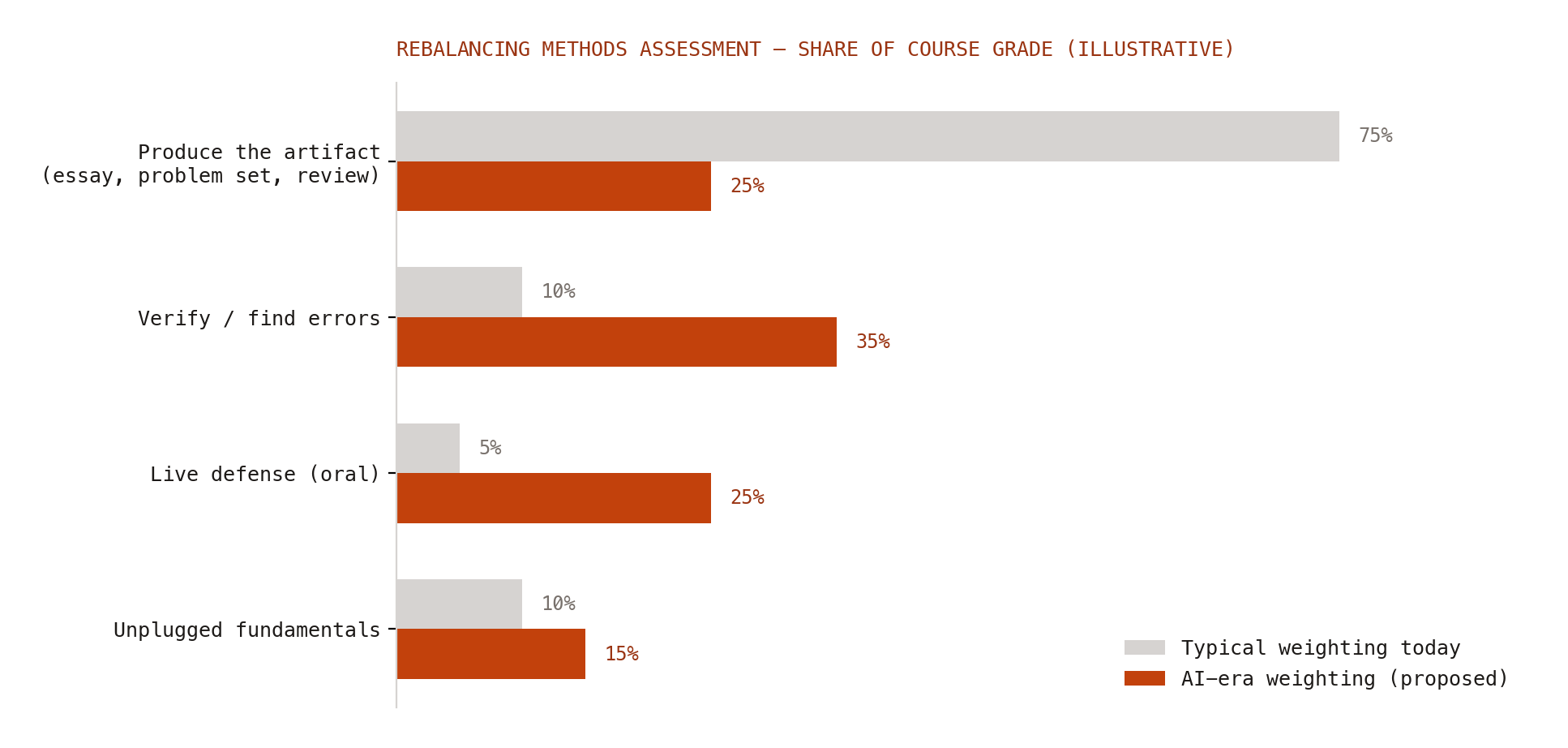
Here is an uncomfortable exercise for anyone teaching pharmacoepidemiology, HEOR, or research methods this fall: take your best assignment — the cohort-design writeup, the bias-identification problem set, the mini literature review — and feed it to a frontier model. If your honest grade for the output is below a B+, either your rubric has slipped or your assignment is testing something other than what you think it is testing.
This is not hypothetical hand-wringing. The same class of systems now documented to outperform human dual review on abstract screening (96.7% vs 81.7% sensitivity) and data extraction (93.1% vs 79.7% accuracy)[1] will not be stumped by a take-home asking students to spot immortal time bias in a vignette. The artifact-based assessment model — student produces document, instructor grades document — quietly assumed the student was the only available producer. That assumption did not survive contact.
The institutions are moving; the assignments mostly are not
To be fair to the field, the institutional layer is responding. Michigan's School of Public Health runs a dedicated "ChatGPT and Public Health" course drawing students from all six of its graduate departments, including biostatistics and epidemiology.[2] At Columbia Mailman, faculty are deploying GPT-based assistants to support students struggling with programming and genomics analysis.[3] ASPPH stood up a task force on responsible and ethical AI use in public health research, practice, and education.[4] Good. Necessary.
But notice what those initiatives mostly are: courses about AI and policies about AI. The harder renovation — what happens inside the ordinary methods course, where the actual competencies are built — is lagging. And the default response there, plagiarism-detection theater, is a losing arms race that converts teachers into cops and students into adversaries. To hell with that. The interesting move is to change what we grade.
Grade the verification, not the artifact
The reframe I would push: in a world of abundant machine-generated analysis, the scarce professional skill is verification — exactly the thing our assessments rarely touch. Four assignment patterns that survive AI, and in fact get better because of it:
Error injection. Give students an AI-generated study critique, protocol, or analysis containing three planted flaws — a time-zero misalignment, a comparator that breaks exchangeability, a miscoded outcome definition. Grade the find rate. This is also, conveniently, the actual job they are graduating into.
Live defense. Ten minutes, no notes: why this comparator, why new-user design, what breaks if we relax it? Oral examination is ancient, unscalable, expensive — and ungameable. Spend your newly liberated grading hours there.
Produce-then-audit. Let students use AI to build the first draft (they will anyway), then require a signed verification memo: what did you check, against what standard, what did the model get wrong? The memo is the deliverable. Honesty about AI's errors becomes the graded behavior — aligning incentives with the truth instead of against it.
Whiteboard fundamentals. Some things — drawing the DAG, walking through person-time by hand, deriving why prevalent users bias the estimate — should be done unplugged, early, precisely because the machine can do them. You cannot audit what you never built. The flight-simulator era makes the instrument-rating exam more important, not less.
The teachers who thrive in the next five years will be the ones who treat AI the way good methods teachers have always treated confounding: not as a scandal to suppress but as the central feature of the landscape, to be understood, measured, and designed around. Our students will spend their careers supervising machines that produce evidence. The kindest thing we can do is stop pretending they won't.