Cumulative Incidence Function (Competing Risks)
Aalen–Johansen estimate of the probability of each event type over time when patients can fail from more than one mutually exclusive cause (e.g., relapse vs death).
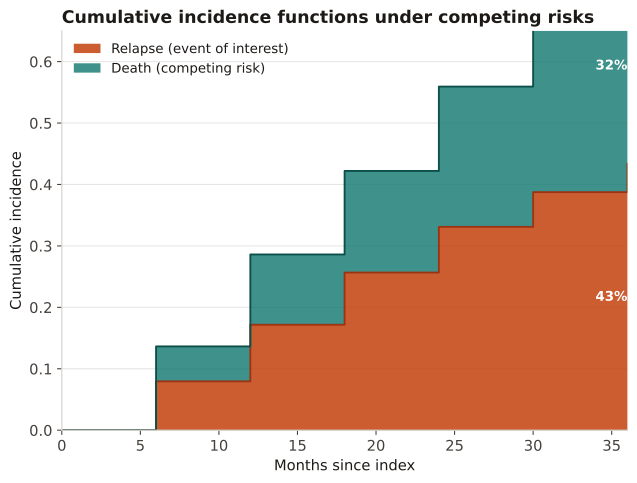
Whenever a competing event removes patients from being at risk for the event of interest (death before relapse). The CIFs for all causes plus event-free sum to 1; a KM '1−S(t)' here would exceed the true incidence.
Each band is the absolute probability of having experienced that event by time t, accounting for the competing event. Stacked heights are additive; the gap to 1.0 is the event-free fraction.
200 patients at risk for relapse (event of interest) with death as a competing risk, followed 36 months. The Aalen–Johansen estimator weights each interval's cause-specific hazard by the overall survival up to that interval: CIF_k(t)=Σ S(t_{i-1})·d_{ki}/n_i.
Result: By 36 months the cumulative incidence of relapse is ≈0.37 and of death ≈0.27; the naïve KM 1−S(t) for relapse alone would have read ≈0.45, overstating relapse risk by treating the 0.27 who died as if still at risk.
Reference: Gatto NM, Wang SV, Murk W, et al. Visualizations throughout pharmacoepidemiology study planning, implementation, and reporting. Pharmacoepidemiol Drug Saf. 2022;31(11):1140-1152.