Prevalent New-User Design Diagram
The prevalent new-user (time-conditional matching) design drawn in the Schneeweiss/Gatto convention — assessment, exposure, and follow-up windows anchored on a timeline so the design's temporal logic is explicit.
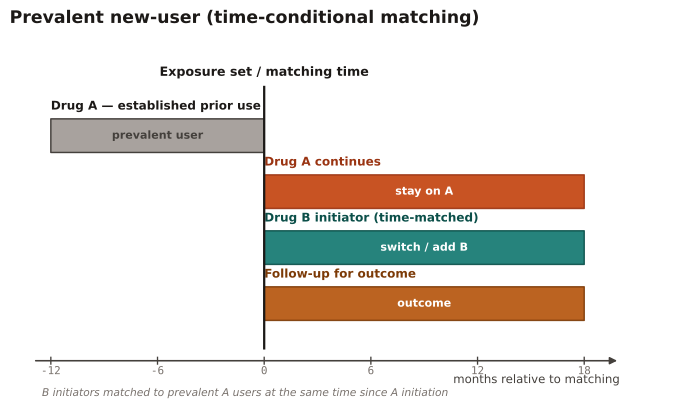
When a strict new-user design discards too many patients (e.g., switchers/augmenters): match initiators of the comparator to prevalent users of the referent drug on time since referent initiation, recovering a valid contrast without losing prevalent users.
Comparator (B) initiators are matched to prevalent referent (A) users at the same time since A initiation (the exposure set), so the two are aligned on disease duration — the look-back is conditioned on that matching time.
An established Drug A user is matched, at a given time since starting A, to a Drug B initiator at the same time-since-A; both are followed forward for the outcome.
Result: Matching on time since referent initiation aligns the arms on disease duration and prior exposure, so the diagram shows how the design avoids both prevalent-user bias and the heavy attrition of a strict new-user restriction.
Reference: Schneeweiss S, Rassen JA, Brown JS, et al. Graphical Depiction of Longitudinal Study Designs in Health Care Databases. Ann Intern Med. 2019;170(6):398-406.