Prevalent New-User Design
Suissa's cohort design for comparative drug-effect studies that lets prevalent users of a comparator enter the study cohort at the moment they switch to or initiate the study drug, matching each on a time-conditional propensity score and on time since comparator initiation, so that the power lost by a strict new-user design is recovered without reintroducing prevalent-user (depletion-of-susceptibles) bias.
On this page
The prevalent new-user design is a way to study how two drugs compare in the real world when most patients reach the second drug by switching from the first one rather than starting it fresh. It lets those switchers into the study, but only at the exact moment they switch, and carefully matches each switcher to a patient who stayed on the original drug and had been on it for the same amount of time. This time-on-drug matching step is what keeps the comparison fair by ensuring both groups have survived the same duration on the comparator drug before the clock starts.
The prevalent new-user (PNU) design (Suissa, Moodie & Dell'Aniello, 2017) is a hybrid between the strict new-user (incident-user) design and an analysis that would naively pool prevalent users. A pure new-user design restricts both arms to patients initiating treatment with no prior use, which cleanly aligns time zero and removes prevalent-user bias but discards the large pool of patients who were already on the comparator drug and then switch to (or add) the study drug.
When the study drug is typically reached by switching from an established comparator — as is common in chronic disease, oncology lines of therapy, and many add-on indications — the strict new-user design can throw away the majority of the real-world treated population, leaving the study underpowered and unrepresentative.
The PNU design recovers those patients: a comparator user becomes eligible to enter the study-drug arm at the time they switch/initiate, and is matched to a comparator user who remains on the comparator and who has the same accumulated treatment history (same time since comparator initiation) and the same time-conditional propensity score for switching at that moment.
Core conceptual mechanism
The design solves two coupled problems that arise when you allow prevalent users in. (1) Aligned, well-defined time zero: each study-drug initiator's follow-up starts at their switch date, and the matched comparator's follow-up starts at the same calendar/treatment-history point, so the two arms share a comparable "now" rather than the study-drug arm being a survivor cohort observed from an arbitrary point. (2) Comparable prior exposure: because patients are matched on time since comparator initiation (the "prevalent" clock), the design balances depletion of susceptibles — the phenomenon whereby people who tolerate a drug and survive on it for years are a healthier, selected subset.
Matching on this clock and on the time-conditional propensity score (TCPS) — the probability of switching at a given moment given covariates measured up to that moment — means the comparator group represents the counterfactual "what if this prevalent user had stayed on the comparator." A single prevalent user can serve as a potential match (a "prevalent-user moment") at several time points, mirroring the risk-set sampling logic of a nested case-control / matched cohort, with the analysis run as a matched cohort (e.g., Cox with a frailty or robust variance for the matched sets).
What it is and is not
The PNU design is an extension of and complement to the active-comparator new-user design, not a replacement for it. It does not license pooling arbitrary prevalent users; the validity hinges on
- being able to model the switching propensity well from longitudinal covariates,
- having enough comparator users at each treatment-history time to form matches, and
- the study drug being reached predominantly by switching rather than by de-novo initiation.
It is also distinct from a target-trial emulation: PNU is a matching-and-time-alignment strategy for the specific switching structure, whereas target-trial emulation is a general framework for specifying the protocol; the two are compatible and PNU can be viewed as one way to operationalize the eligibility/time-zero rules of an emulated switching trial.
Pros, cons, and trade-offs
- vs the strict `new-user-design`: PNU recovers the (often large) population of switchers that the incident-user design discards, restoring power and external validity for drugs that are reached by switching, while still controlling prevalent-user/depletion bias through matching on time since comparator initiation and the TCPS. Cost: it requires longitudinal data rich enough to estimate the switching propensity over time and is more complex to implement and explain. Prefer the strict new-user design when de-novo initiation is the real-world reality and a clean incident cohort is large enough; prefer PNU when most patients reach the study drug by switching and the new-user cohort would be small or unrepresentative.
- vs the `active-comparator-new-user` design: Active-comparator new-user fixes confounding by indication by comparing two initiators with the same indication; PNU keeps that spirit but extends the eligible population to comparator-to-study-drug switchers, matching at the switch moment. Prefer active-comparator new-user when two drugs are genuinely interchangeable first-line options; prefer PNU when the study drug is a later-line or add-on/switch therapy so that "new use" of the study drug coincides with prevalent use of the comparator.
- vs accepting `prevalent-user-bias` (naive pooling of prevalent users): Naive prevalent-user comparisons mix aligned and misaligned time zeros, condition on survival, and bias estimates unpredictably. PNU is the principled way to include prevalent users without that bias. Never prefer naive pooling; PNU exists precisely to avoid it.
When NOT to use — and when it is actively misleading or dangerous
- When de-novo initiation is the actual clinical pattern. If patients genuinely start the study drug as a first treatment, a strict new-user design is cleaner and PNU adds complexity with no gain; forcing a switching structure where none exists misrepresents the population.
- When the time-conditional switching propensity cannot be credibly modeled. PNU's bias control rests entirely on the TCPS and on matching the prevalent clock; if longitudinal covariates are sparse or switching is driven by unrecorded factors (e.g., unmeasured disease progression), the matched comparator is not a valid counterfactual and the estimate is confounded — reporting it as bias-controlled is misleading.
- When there are too few comparator users at each treatment-history time to match. Sparse risk sets force coarse matching or dropped switchers, reintroducing imbalance; check match rates and balance by the prevalent clock before trusting the result.
- When the prevalent clock is ignored. Matching only on a baseline propensity score while allowing prevalent users in reintroduces depletion-of-susceptibles bias; the time-since-comparator-initiation match is not optional.
Data-source operational depth
- Claims (FFS vs MA): The natural substrate — dispensing records give exposure start, switch dates, and the longitudinal covariate stream (diagnoses, prior fills, utilization) needed for the TCPS. Build the prevalent clock from the first observable comparator fill within a continuously enrolled, FFS-observable window; Medicare Advantage enrollees generate no fee-for-service claims, so MA-only spans corrupt both the prevalent clock and the switching-propensity covariates — restrict to FFS-observable person-time. Define switching with explicit grace/gap rules so an add-on is not misread as a switch.
- EHR: Medication orders, problem lists, labs, and vitals give richer time-varying covariates for the switching model (disease severity, response markers), sharpening the TCPS, but encounter-driven capture and out-of-system care mean the switch date and prior-exposure clock may be incomplete; require demonstrable in-system activity and reconcile order vs fill.
- Registry / linked: Disease registries supply adjudicated severity and line-of-therapy information that materially improves the switching propensity and the time-since-initiation clock; linked claims-EHR is the strongest substrate but introduces linkage selection that must be reported.
Decision diagram
flowchart TD
  Init[Patient initiates comparator drug] --> Clock[Prevalent clock starts<br/>t = time since comparator initiation]
  Clock --> Risk{At time t,<br/>does the patient switch to study drug?}
  Risk -->|Yes switches| SW[Enters STUDY-DRUG arm<br/>time zero = switch date]
  Risk -->|No continues| CC[Eligible COMPARATOR match<br/>at the same t]
  SW --> Match[Match on time-conditional PS<br/>AND on t time since initiation]
  CC --> Match
  Match --> Cohort[Matched cohort<br/>aligned time zero + comparable prior exposure]
Cohort --> Cox[Outcome model<br/>Cox with robust/frailty variance for matched sets]flowchart TD
Q{How do real-world patients<br/>reach the study drug?} -->|De-novo initiation| NU[Strict new-user design<br/>clean incident cohort]
Q -->|Predominantly by switching<br/>from a comparator| PNU{Can you model the<br/>time-conditional switching PS?}
PNU -->|Yes + enough comparator matches| Use[Prevalent new-user design<br/>match on TCPS + prevalent clock]
PNU -->|No / sparse risk sets| Caution[Do NOT naively pool prevalent users<br/>reintroduces depletion bias]Worked example
Scenario
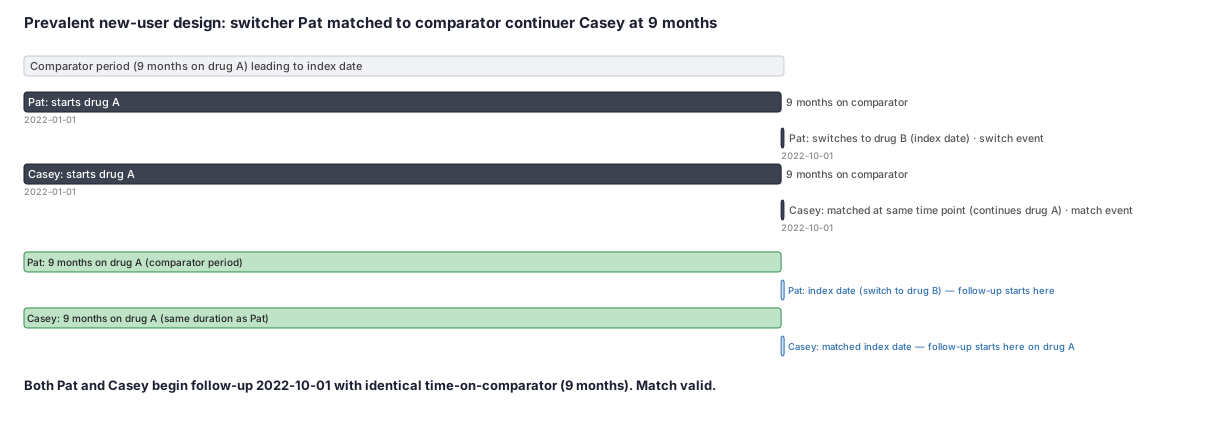
We want to compare drug B (a newer oral diabetes medication) against drug A (the established standard). Drug B is only prescribed to patients who tried drug A first and then switched. We identify a patient, Pat, who started drug A on 2022-01-01 and switched to drug B 9 months later on 2022-10-01. Under a strict new-user design, Pat would be excluded because Pat is not a fresh starter of drug A. Under the prevalent new-user design, Pat enters the study-drug arm at the switch date (2022-10-01). We then find a match for Pat: another patient, Casey, who started drug A on 2022-01-01 (so also 9 months into drug A as of 2022-10-01) and did not switch. Both Pat and Casey begin their study follow-up on 2022-10-01.
Dataset
Key dates and measurements for the switcher (Pat) and the matched comparator continuer (Casey) as they would appear in a linked claims file.
| person_id | comparator_start | index_date | months_on_comparator_at_index | arm |
|---|---|---|---|---|
| PAT-001 | 2022-01-01 | 2022-10-01 | 9 | study_drug_B |
| CASEY-002 | 2022-01-01 | 2022-10-01 | 9 | comparator_drug_A |
Steps
Result
One matched pair: Pat (9 months on drug A then switched to drug B) versus Casey (9 months on drug A, continuing). Follow-up for both starts 2022-10-01. The design recovers Pat for the analysis instead of discarding this common real-world switcher.
Trade-offs
Runnable example
Prevalent new-user matching on a time-conditional propensity score (TCPS) and the prevalent clock, on illustrative longitudinal claims-style data. Inputs: a person-period table (person_id, t = months since comparator initiation, on_study = 1 in the period the person switches to the study drug, plus time-varying...
import numpy as np
import pandas as pd
import statsmodels.formula.api as smf

# Illustrative person-period data: one row per person per month since comparator initiation.
rng = np.random.default_rng(3)
rows = []
for pid in range(2000):
    comorb = rng.binomial(1, 0.3); age = rng.normal(60, 10)
    switched = False
    for t in range(1, 25):                       # months on the comparator
        if switched:
            break
        p_switch = 1/(1+np.exp(-(-4 + 0.03*(age-60) + 0.8*comorb + 0.04*t)))
        on_study = rng.binomial(1, p_switch)     # switch to study drug this month?
        rows.append(dict(person_id=pid, t=t, on_study=on_study, age=age, comorb=comorb))
        switched = bool(on_study)
pp = pd.DataFrame(rows)

# Time-conditional propensity score: probability of switching at month t given covariates up to t.
tcps = smf.logit("on_study ~ age + comorb + t", data=pp).fit(disp=0)
pp["ps"] = tcps.predict(pp)

# Within each prevalent-clock time t, nearest-neighbor match switchers to comparator continuers on the TCPS.
matches = []
for t, g in pp.groupby("t"):
    switchers = g[g.on_study == 1]
    controls  = g[g.on_study == 0].copy()
    for _, s in switchers.iterrows():
        if controls.empty:
            continue
        j = (controls["ps"] - s["ps"]).abs().idxmin()      # closest TCPS at the same t
        matches.append((s["person_id"], controls.loc[j, "person_id"], t))
        controls = controls.drop(j)                        # match without replacement within t
matched = pd.DataFrame(matches, columns=["study_id", "comparator_id", "match_time"])
print(f"switchers matched: {len(matched)} (each pair shares t and TCPS)")
print(matched.head())
Prevalent new-user matching with the MatchIt package on illustrative person-period claims-style data (person_id, t = months since comparator initiation, on_study, age, comorb). A pooled logistic model gives the time-conditional propensity score and MatchIt performs exact matching on the prevalent clock t with...
library(MatchIt)
set.seed(3)

# Illustrative person-period data: one row per person per month since comparator initiation.
mk <- function() {
  comorb <- rbinom(1, 1, 0.3); age <- rnorm(1, 60, 10); out <- list(); sw <- FALSE
  for (t in 1:24) {
    if (sw) break
    p  <- plogis(-4 + 0.03*(age-60) + 0.8*comorb + 0.04*t)
    on <- rbinom(1, 1, p)
    out[[t]] <- data.frame(t = t, on_study = on, age = age, comorb = comorb)
    sw <- on == 1
  }
  do.call(rbind, out)
}
pp <- do.call(rbind, lapply(1:2000, function(i) cbind(person_id = i, mk())))

# Time-conditional PS via pooled logistic; exact-match the prevalent clock t, NN-match the TCPS.
m <- matchit(on_study ~ age + comorb + t,
             data = pp, method = "nearest", distance = "glm",
             exact = ~ t, ratio = 1)        # exact on time since comparator initiation
summary(m)                                  # balance of the TCPS and covariates within t
matched <- match.data(m)                    # feed to a downstream Cox on the matched cohort
cat(sprintf("matched rows: %d\n", nrow(matched)))
Prevalent new-user matching in SAS with no dedicated PROC: PROC LOGISTIC estimates the time-conditional propensity score from the person-period data (work.pp: person_id, t = months since comparator initiation, on_study, age, comorb), then a greedy nearest-neighbor match within each prevalent-clock time t is done in...
/* Time-conditional propensity score: P(switch at month t | covariates up to t). */
proc logistic data=work.pp noprint;
  model on_study(event='1') = age comorb t;
  output out=pp_ps p=ps;                       /* predicted switching probability */
run;

/* Split into switchers and comparator continuers, carrying the prevalent clock t and the TCPS. */
data switchers controls;
  set pp_ps;
  if on_study = 1 then output switchers;
  else output controls;
run;

/* Greedy nearest-neighbor match WITHIN each t on the TCPS (no fetch-first; ranked join + dedup). */
proc sql;
  create table cand as
  select s.person_id as study_id, c.person_id as comparator_id, s.t as match_time,
         abs(s.ps - c.ps) as psdiff
  from switchers s inner join controls c
    on s.t = c.t                               /* exact match on time since comparator initiation */
  group by s.person_id
  having calculated psdiff = min(abs(s.ps - c.ps));   /* closest TCPS control per switcher */
quit;

/* Enforce one control per switcher (dedupe ties), then this matched set feeds PROC PHREG. */
proc sort data=cand; by study_id psdiff; run;
data matched; set cand; by study_id; if first.study_id; run;
proc print data=matched(obs=10) noobs; run;
Citations
- [1]Suissa S, Moodie EEM, Dell'Aniello S. Prevalent new-user cohort designs for comparative drug effect studies by time-conditional propensity scores. Pharmacoepidemiology and Drug Safety. 2017;26(4):459-468.
- [2]Lund JL, Richardson DB, Sturmer T. The active comparator, new user study design in pharmacoepidemiology: historical foundations and contemporary application. Current Epidemiology Reports. 2015;2(4):221-228.
- [3]Gagne JJ. New-user designs with conditional propensity scores: a unified complement to the traditional active comparator new-user approach. Pharmacoepidemiology and Drug Safety. 2017;26(4):469-471.