Time Zero (Index Date) Alignment
The design rule that fixes a single date per patient at which eligibility is met, treatment strategy is assigned, baseline covariates stop being measured, and follow-up and outcome risk begin—so that classification, person-time, and confounder measurement are synchronized exactly as they would be at randomization in the trial being emulated.
On this page
Time-zero alignment is the rule that picks one single date per patient where the clock starts: the day they qualify for the study, the day we decide which treatment group they are in, and the day we begin counting their follow-up and watching for outcomes. It answers the question, "From exactly when should we start measuring this patient, so we are comparing the two groups fairly the way a coin-flip trial would?" Get this date wrong and you can hand one group free, event-free time it never actually earned, which fakes a benefit that isn't real. The catch: you may only use information you'd know on or before that day to sort a patient into a group.
Time zero
(the index date, t0, or cohort-entry date) is the instant at which a patient simultaneously
- satisfies all eligibility criteria,
- is assigned to a treatment strategy,
- has baseline covariates fixed (everything measurable up to and including t0, nothing after), and
- begins to accrue person-time and outcome risk. In a randomized trial these four events coincide by construction at randomization. In observational data they do not coincide unless the analyst forces them to, and the entire validity of a longitudinal RWE study rests on doing so.
The discipline of aligning eligibility, assignment, and follow-up onset at one date is the operational heart of target-trial emulation; getting it wrong is the single most common source of catastrophic, non-fixable bias in pharmacoepidemiology.
Core conceptual distinction
The defining requirement is that exposure classification must be determinable using only information available at or before t0. The failure mode is using future information to define cohort entry or arm assignment, which guarantees that the classified-exposed group must survive (and remain event-free) long enough to receive exposure—immortal time bias. The classic example: define "statin user" as anyone who fills a statin during follow-up, but start the clock at hospital discharge.
Patients who die in week one cannot become "users," so the user group banks event-free person-time it never earned.
Three distinct biases all trace to t0 misalignment and must be separated:
- immortal time—follow-up starts before the moment exposure is determined;
- prevalent-user / left-truncation bias—t0 is set at an arbitrary calendar date among ongoing users, conditioning on survival and depleting susceptibles;
- differential alignment by arm—the two strategies' t0 dates correspond to different points in the disease course (e.g., the new drug is reached only after the comparator fails), embedding confounding by indication into the time axis itself.
The estimand you can recover is governed by what t0 represents: if t0 = initiation, the contrast is an initiation (ITT-like) effect; if a grace period is allowed for a strategy to be "started," eligibility-time ambiguity arises and the per-protocol estimand requires cloning/censoring/weighting rather than a single assigned t0.
Pros, cons, and trade-offs
- vs an "ever-exposed" / time-fixed classification with follow-up from diagnosis: Aligning t0 at the exposure decision eliminates immortal time entirely; the ever-exposed approach is not a milder version of the same design, it is a different and biased estimand. There is no analytic patch (no covariate adjustment, no PS) that repairs misclassified person-time.
Always prefer
aligned t0; the only legitimate alternative when exposure genuinely accrues after a fixed eligibility event is to model exposure as time-varying (landmark analysis or a time-dependent Cox/pooled-logistic model), which is a deliberate analytic choice, not a default.
- vs prevalent-user (current-user at a calendar date) designs: A new-user t0 at first qualifying fill removes left-truncation, depletion-of-susceptibles, and adjustment for post-initiation mediators. Cost: smaller cohorts and a population restricted to initiators, who can differ from the prevalent users who dominate practice. Prefer aligned new-user t0; reach for a prevalent new-user (Suissa) design only when incident initiation is too rare to study.
- vs single-decision t0 with clone-censor-weight (CCW): When a strategy is defined by a sustained or dynamic regimen, or when a grace period makes "the" assignment date ambiguous (patients who could start within X days all qualify for both strategies at baseline), a single hard t0 forces an artificial choice and reintroduces selection.
CCW assigns every eligible person to all compatible strategies at t0, then censors and weights as their data diverge. Cost: substantially more complex to specify, fit, and defend. Prefer a single aligned t0 for clean two-drug initiation contrasts; escalate to CCW only when the protocol genuinely requires a dynamic per-protocol estimand.
When NOT to use — and when it is actively misleading or dangerous
- Do not set a single fixed t0 when exposure is intrinsically post-baseline and time-varying (e.g., effect of achieving a lab target, of cumulative dose, or of adherence measured over follow-up). Forcing these into a baseline classification creates immortal time. Use landmark or time-dependent models instead.
- Do not anchor t0 on a downstream event (first hospitalization for the outcome's complication, second prescription, "confirmed responder"). Conditioning cohort entry on a future event selects on survival and on the outcome pathway.
- Do not let the two arms' t0 represent different clinical moments. If the comparator's t0 is first-line initiation but the study drug's t0 is post-failure switch, the time axes are not exchangeable; balance tables will look fine yet the estimate is confounded by indication baked into t0. This is the most dangerous case because it is invisible to standardized differences computed at each arm's own baseline.
- Do not assign t0 from a procedure that itself defines survival (e.g., transplant, complex surgery) without a g-method or sequential-trial design; "time to procedure" is immortal by construction.
Data-source operational depth
- Administrative claims (FFS vs Medicare Advantage): t0 is typically the `fill_date` of the first qualifying NDC or the service date of a qualifying procedure. The lethal trap is MA-only person-time: capitated Medicare Advantage plans do not generate complete FFS encounter/pharmacy claims, so a clean washout before t0 can be missingness masquerading as incidence, and competing events (death) are unevenly captured.
Require continuous A/B/D (or commercial medical+pharmacy) enrollment spanning the entire washout through t0, and exclude MA-only spans rather than treating them as drug-free. Reversed/rebilled and same-day mail-order + retail fills can split or duplicate the index event—dedupe before taking the minimum date. In elderly cohorts, differential competing risk of death by arm distorts cause-specific vs cumulative- incidence interpretation, which must be reconciled with the estimand. - EHR: The exposure decision is the order or administration, not a dispensing; an order without a confirmed fill is an intention, not an initiation, so linkage to pharmacy claims sharpens t0.
Visit-driven capture means baseline covariates are observed only when a patient happens to have an encounter, so the "up-to-t0" window can be sparse and informatively missing; a patient who leaves the system contributes biased follow-up. Define the observation window explicitly and treat loss to follow-up as potentially informative.
- Registry: Strong for the qualifying clinical event (diagnosis date, stage, adjudicated index procedure) that often is t0, but typically blind to subsequent pharmacy exposure and to deaths occurring outside the registry. Link to claims for fill history and to a death index to firm up censoring; verify the registry's enrollment/adjudication date is not itself a post-hoc, outcome-informed date.
- Linked claims–EHR–vital records: The ideal substrate (EHR severity + claims completeness + reliable mortality) but order date, fill date, and service date frequently disagree by days to weeks; pre-specify which date defines t0 and reconcile the others before assignment, because a few days' slippage changes who is "incident" and whether a baseline covariate falls before or after t0.
Worked claims example (immortal time made concrete)
Question: 1-year all-cause mortality after acute MI in patients who initiate a beta-blocker vs those who do not, in a commercial + Medicare FFS database.
Naive (wrong) analysis: t0 = MI discharge date for everyone; classify "beta-blocker user" = any beta-blocker `fill_date` in the 90 days after discharge. Result: the user arm is artificially protected, because anyone who dies in days 1–89 before filling is forced into the non-user arm—the days from discharge to first fill are immortal (event-free by definition) and wrongly credited to users.
Aligned analysis: require ≥365 days continuous A/B/D enrollment with no beta-blocker fill in the 365-day lookback (washout, so initiation is incident, MA-only spans excluded). Set t0 = first post-discharge beta-blocker `fill_date` for initiators; for the comparator, use a sequential/landmark device—e.g., assign each non-filling-survivor a matched t0 at the same number of days post-discharge (or build a sequence of nested trials by day), so both arms start the clock at the same elapsed time and the immortal interval is removed from both.
Measure baseline covariates only in `[t0 − 365, t0]` (prior comorbidities, utilization, infarct severity proxies), fit a PS, and follow from t0 to death, censoring at disenrollment, end of data, and (for an as-treated estimand) discontinuation = last `days_supply` end + a 30-day grace period or switch.
Report the t0 distribution by arm and rerun with the washout and grace period at ±30/90 days. The aligned design typically shrinks the spurious "beta-blocker" benefit by a large margin—the textbook signature of corrected immortal time.
Decision diagram
flowchart TD
  Pop[Source population meeting clinical eligibility] --> Wash[Continuous enrollment + washout<br/>no prior study/comparator exposure]
  Wash --> Decide{Is exposure determinable<br/>at a single decision date?}
  Decide -->|Yes: incident initiation/procedure| T0[Time zero = that date<br/>assign arm from info <= t0 only]
  Decide -->|No: exposure accrues over follow-up| TV[Time-varying / landmark / sequential trials<br/>do NOT fix one baseline class]
  T0 --> Base[Baseline covariates measured only in t0 - washout, t0 -> PS]
  TV --> Base
  Base --> Fup[Follow-up starts at t0<br/>identical outcome + censoring rules both arms]
Fup --> Sens[Diagnostics: t0 distribution by arm, attrition,<br/>patient timelines, washout/grace sensitivity]gantt title Immortal time created by misaligned t0 (and how alignment fixes it) dateFormat YYYY-MM-DD axisFormat %b %Y section WRONG: follow-up from discharge, exposure from future Eligibility event (discharge) :milestone, m1, 2024-01-01, 0d Immortal interval (must survive to fill) :crit, imm, 2024-01-01, 60d First exposure fill (used to classify) :milestone, m2, 2024-03-01, 0d section RIGHT: aligned time zero Washout + continuous enrollment :done, w, 2023-01-01, 2023-12-31 Time zero = first qualifying fill :milestone, t0, 2024-03-01, 0d Follow-up at risk from t0 :active, fu, 2024-03-01, 180d
Worked example
Scenario
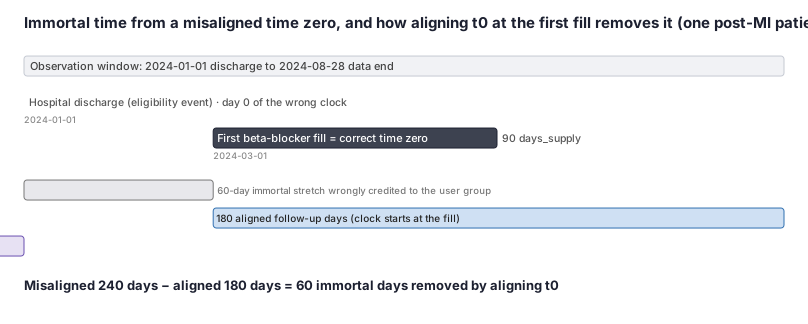
One patient is discharged from the hospital after a heart attack on 2024-01-01 and we want to study whether starting a beta-blocker lowers 1-year death. They fill their first beta-blocker on 2024-03-01. We compare a wrong way to start the clock (at discharge, but label them a "user" using a fill that happens later) against the right way (start the clock on the fill date). The window we can observe ends 2024-08-28.
Dataset
The raw rows an analyst would see: one discharge record, one enrollment span, and one pharmacy fill.
| person_id | event_type | date | drug | days_supply |
|---|---|---|---|---|
| 2001 | hospital_discharge | 2024-01-01 | ||
| 2001 | enrollment_span_start | 2023-01-01 | ||
| 2001 | pharmacy_fill | 2024-03-01 | beta_blocker | 90 |
Steps
Result
Misaligned follow-up = 240 days vs aligned follow-up = 180 days; the misaligned design credits 60 extra event-free (immortal) days (2024-01-01 to 2024-03-01) to the beta-blocker group that aligning time zero at the 2024-03-01 fill removes.
Trade-offs
Runnable example
Time-zero assignment from claims-style inputs, with an explicit immortal-time guard. Required inputs (already cleaned and de-duplicated): rx : pharmacy fills -> person_id, fill_date (datetime64), drug_class in {'STUDY','COMPARATOR'}, days_supply (int) enroll : enrollment spans -> person_id, enroll_start, enroll_end...
import pandas as pd

WASHOUT_DAYS = 365  # drug-free + continuous-enrollment lookback that defines an incident (new) user

def assign_time_zero(rx: pd.DataFrame, enroll: pd.DataFrame) -> pd.DataFrame:
    rx = rx.sort_values(["person_id", "fill_date"])
    study = rx[rx["drug_class"].isin(["STUDY", "COMPARATOR"])].copy()

    # De-duplicate same-day/rebilled fills so the index event is a single row, then take the EARLIEST qualifying fill.
    study = study.drop_duplicates(subset=["person_id", "fill_date", "drug_class"])
    idx = (study.groupby("person_id", as_index=False)
                .first()
                .rename(columns={"fill_date": "index_date", "drug_class": "arm"}))

    # Immortal-time guard: t0 (= the first qualifying fill) is by construction the classification date.
    # Assert no fill used for arm assignment occurs AFTER the index date -> classification uses only info <= t0.
    chk = study.merge(idx[["person_id", "index_date"]], on="person_id")
    offending = chk[chk["fill_date"] < chk.groupby("person_id")["fill_date"].transform("min")]
    assert offending.empty, "arm assignment must use only the earliest fill (no post-t0 information)"

    # New-user: no study/comparator fill in the washout window strictly before t0.
    prior = study.merge(idx[["person_id", "index_date"]], on="person_id")
    in_washout = prior[(prior["fill_date"] < prior["index_date"]) &
                       (prior["fill_date"] >= prior["index_date"] - pd.Timedelta(days=WASHOUT_DAYS))]
    idx = idx[~idx["person_id"].isin(in_washout["person_id"])].copy()

    # Continuous, FFS-observable enrollment spanning the full washout through t0 (no MA-only gaps).
    e = enroll.merge(idx[["person_id", "index_date"]], on="person_id")
    e["covers"] = ((e["enroll_start"] <= e["index_date"] - pd.Timedelta(days=WASHOUT_DAYS)) &
                   (e["enroll_end"]   >= e["index_date"]) & (~e["ma_only"]))
    eligible = e.loc[e["covers"], "person_id"].unique()

    cohort = idx[idx["person_id"].isin(eligible)].copy()
    cohort["baseline_start"] = cohort["index_date"] - pd.Timedelta(days=WASHOUT_DAYS)  # covariate window opens here
    return cohort[["person_id", "arm", "index_date", "baseline_start"]]
Time-zero assignment with data.table; inputs mirror the Python version. rx : person_id, fill_date (Date), drug_class in {'STUDY','COMPARATOR'}, days_supply (int) enroll : person_id, enroll_start, enroll_end (Date), ma_only (logical) Stops with an error if arm assignment would use anything other than the earliest...
library(data.table)
WASHOUT_DAYS <- 365L

assign_time_zero <- function(rx, enroll) {
  setDT(rx); setDT(enroll)
  study <- rx[drug_class %chin% c("STUDY", "COMPARATOR")]
  # Drop same-day / rebilled duplicates, then take the EARLIEST qualifying fill as t0 and arm.
  study <- unique(study, by = c("person_id", "fill_date", "drug_class"))
  setorder(study, person_id, fill_date)
  idx <- study[, .(index_date = fill_date[1L], arm = drug_class[1L]), by = person_id]

  # Immortal-time guard: classification must rest on the first fill only.
  stopifnot(nrow(study[fill_date < study[, min(fill_date), by = person_id][idx, on = "person_id", V1]]) == 0L)

  # New-user: no study/comparator fill in the washout window strictly before t0.
  study2 <- merge(study, idx[, .(person_id, index_date)], by = "person_id")
  prior_ids <- unique(study2[fill_date < index_date &
                             fill_date >= index_date - WASHOUT_DAYS, person_id])
  idx <- idx[!person_id %chin% prior_ids]

  # Continuous, FFS-observable enrollment across the full washout through t0 (no MA-only spans).
  e <- merge(enroll, idx[, .(person_id, index_date)], by = "person_id")
  ok <- e[enroll_start <= index_date - WASHOUT_DAYS &
          enroll_end   >= index_date & !ma_only, unique(person_id)]

  cohort <- idx[person_id %chin% ok]
  cohort[, baseline_start := index_date - WASHOUT_DAYS]
  cohort[, .(person_id, arm, index_date, baseline_start)]
}
Time-zero assignment and an immortal-time-safe time-to-event setup in SAS. Required input datasets (post data-management): work.rx : person_id, fill_date, drug_class ('STUDY'/'COMPARATOR'), days_supply work.enroll : person_id, enroll_start, enroll_end, ma_only (0/1) work.outcome: person_id, event_date, death_date,...
%let washout = 365;

/* Earliest study/comparator fill = candidate t0, with arm = drug_class on that fill (info available at/<= t0 only). */
proc sort data=work.rx(where=(drug_class in ('STUDY','COMPARATOR'))) out=rx_q;
  by person_id fill_date;
run;

data idx;
  set rx_q;
  by person_id;
  if first.person_id;
  index_date = fill_date;
  format index_date date9.;
  length arm $12;
  arm = drug_class;
  keep person_id index_date arm;
run;

/* New-user restriction: no prior study/comparator fill inside the washout window before t0. */
proc sql;
  create table newuser as
  select i.* from idx i
  where not exists (
    select 1 from work.rx p
    where p.person_id = i.person_id and p.drug_class in ('STUDY','COMPARATOR')
      and p.fill_date <  i.index_date
      and p.fill_date >= i.index_date - &washout);
quit;

/* Continuous, FFS-observable enrollment across the full washout through t0 (exclude MA-only spans). */
proc sql;
  create table cohort as
  select n.person_id, n.arm, n.index_date,
         n.index_date - &washout as baseline_start format=date9.
  from newuser n
  where exists (
    select 1 from work.enroll e
    where e.person_id = n.person_id and e.ma_only = 0
      and e.enroll_start <= n.index_date - &washout
      and e.enroll_end   >= n.index_date);
quit;

/* Build follow-up time and a competing-risk-aware status FROM t0 (this alignment is what removes immortal time). */
data analysis;
  merge cohort(in=a) work.outcome;
  by person_id;
  if a;
  end_date = min(coalesce(event_date, data_end_date),
                 coalesce(death_date, data_end_date),
                 coalesce(disenroll_date, data_end_date), data_end_date);
  futime = end_date - index_date;                 /* clock starts at t0, never before */
  if (event_date ne . and event_date <= end_date) then status = 1;       /* event of interest */
  else if (death_date ne . and death_date <= end_date) then status = 2;  /* competing death  */
  else status = 0;                                                       /* censored          */
run;

/* Cause-specific hazard (censors competing deaths): */
proc phreg data=analysis;
  class arm(ref='COMPARATOR');
  model futime*status(0 2) = arm;                 /* status=2 treated as censored -> cause-specific HR */
run;

/* Subdistribution (Fine-Gray) for the cumulative-incidence estimand under competing death: */
proc phreg data=analysis;
  class arm(ref='COMPARATOR');
  model futime*status(0) = arm / eventcode=1;     /* event of interest = 1, death = competing */
run;
Citations
- [1]Hernán MA, Sauer BC, Hernández-Díaz S, Platt R, Shrier I. Specifying a target trial prevents immortal time bias and other self-inflicted injuries in observational analyses. Journal of Clinical Epidemiology. 2016;79:70-75.
- [2]Hernán MA, Robins JM. Using big data to emulate a target trial when a randomized trial is not available. American Journal of Epidemiology. 2016;183(8):758-764.
- [3]Suissa S. Immortal time bias in pharmacoepidemiology. American Journal of Epidemiology. 2008;167(4):492-499.