Grace Period and Permissible Gap Rules
The pre-specified maximum allowable gap between consecutive dispensings (or administrations/visits) before exposure is considered discontinued and an exposure episode is closed, determining persistence, on-treatment person-time, and exposure misclassification.
On this page
A grace period (also called a permissible gap) is a pre-set number of days that a researcher allows to pass between the end of one prescription fill and the start of the next before deciding that a patient has actually stopped taking the drug. When a gap between fills is shorter than the grace period, the treatment episode stays open — the interruption is treated as a brief delay at the pharmacy, not a real stop. When the gap is longer than the grace period, the episode is closed and the patient is recorded as having discontinued treatment at the point their last supply ran out. Choosing the grace period is one of the most consequential decisions in any study that tracks how long patients stay on a drug, because a shorter window labels more patients as quitters while a longer window can make poor adherers look persistent.
A grace period (permissible gap) rule is the operational decision that converts a sequence of discrete dispensing records into continuous exposure episodes. Each fill confers a covered window of length `days_supply` starting at `fill_date`.
When the next fill arrives before that window expires (allowing for stockpiling) the episode continues; when the gap between the run-out date of one fill and the start of the next exceeds the grace period, the episode is closed and the patient is classified as having discontinued at the run-out date (often plus a fraction of the grace period). The grace period is therefore not a nuisance parameter — it simultaneously defines who is persistent, how much on-treatment person-time each patient contributes, and where exposure is misclassified.
Gardarsdottir et al. showed empirically that the number, length, and count of constructed treatment episodes is directly governed by the gap length chosen, which is why the rule must be specified in the protocol and varied in sensitivity analysis rather than left to a default.
Core conceptual distinction
The grace period is distinct from, but interacts with, three neighboring constructs.
- Grace period vs days_supply / stockpiling rule: `days_supply` sets the nominal covered window; the stockpiling (carry-over) rule decides whether early refills bank surplus supply forward; the grace period is the slack added after the (possibly carried-over) supply runs out before discontinuation is declared.
- Permissible gap vs episode-gap (new-episode) threshold: a short grace period bridges within-episode interruptions; a separate, usually longer, threshold governs whether a return after a long gap starts a new episode (re-initiation/rechallenge) versus continuing the old one.
- Grace period as exposure-window definition vs as a censoring/lag device: in an as-treated analysis the grace period extends the on-treatment window (and thus attributes more outcomes to the drug); in an intention-to-treat/first-line analysis the grace period mainly affects the persistence endpoint, not outcome attribution.
The estimand must state which. The fundamental trade-off is bias-directional: too short a grace period creates spurious discontinuations and gaps (artifactual non-persistence, and immortal-time/exposure misclassification if outcomes occurring during the "gap" are treated as unexposed), while too long a grace period carries non-adherent person-time as "exposed," diluting both benefit and harm toward the null and inflating apparent persistence.
Pros, cons, and trade-offs
(vs the specific alternatives):
- vs a fixed default gap (e.g., 30 days for everyone): A drug-class-calibrated, refill-pattern-informed grace period (e.g., 50% of typical `days_supply`, or an empirically derived gap distribution) reduces differential misclassification across drugs with different refill cadence (90-day mail-order vs 30-day retail) and different half-lives. Cost: more programming and a defensible justification per drug. Prefer a calibrated rule for any comparative or regulatory study where two arms have different supply patterns.
- vs no grace period (strict run-out = discontinuation): A grace period prevents counting routine refill timing variation (weekend pickups, mail-order lag, sample/free supply) as discontinuation. Cost: it lengthens on-treatment person-time and can mask true early stopping. Prefer a grace period in essentially all persistence and as-treated analyses; prefer strict run-out only for conservative safety signal detection where over-attributing exposure is the worse error.
- vs an as-treated analysis with informative-censoring weights: A grace period plus simple censoring at episode end is transparent and defensible but ignores that discontinuation is rarely random. Cost: differential discontinuation by arm biases naive as-treated estimates. Prefer adding inverse-probability-of-censoring weights (or an ITT/first-line contrast) when discontinuation is common and arm-dependent; the grace period alone does not fix informative censoring.
When NOT to use — and when it is actively misleading or dangerous
.
- Do not let a single grace period span arms with different refill cadence (e.g., a once-daily oral with 90-day mail-order vs a titrated agent with 30-day retail fills). A common absolute gap (say 30 days) is lenient for the 30-day drug and strict for the 90-day drug, producing differential exposure misclassification that biases the comparison in an unpredictable direction. Calibrate per drug or express the gap as a proportion of `days_supply`.
- Do not apply a refill-based grace period to drugs not captured as outpatient pharmacy claims. Clinician-administered infusions/injectables (J-codes on the medical claim), inpatient-dispensed drugs, and 340B/white-bagged products have no `days_supply`; a pharmacy grace-period rule silently classifies all such person-time as unexposed.
- Do not treat outcomes occurring inside the grace period as unexposed in an as-treated analysis — that is a recipe for immortal-time-style misclassification. The grace-period window must be classified as exposed (or the analysis must use a time-varying exposure with an explicit lag), not retro-assigned based on whether a refill eventually appeared.
- Do not use a long grace period when the question is early discontinuation or first-fill-only (primary non-adherence). A long grace masks exactly the signal of interest.
Data-source operational depth
.
- Claims (FFS): The native substrate — `person_id`, `fill_date`, `days_supply`, NDC. Require continuous medical + pharmacy enrollment across the episode so an apparent gap is a true treatment gap, not unobserved person-time. Failure modes: Medicare Advantage (MA-only) person-time lacks adjudicated FFS pharmacy claims, so a "gap" can be pure missingness — restrict to Part D / commercial pharmacy-benefit enrollment and exclude MA-only spans before applying the rule. 90-day mail-order and 100-day supplies inflate `days_supply`; samples, $4 generics, and cash purchases are invisible and manufacture false gaps; same-day duplicate/reversed claims and partial fills distort run-out dates (de-duplicate and net out reversals first); claims adjudication lag at the end of the data window truncates the last episode.
- EHR: Exposure is the order or medication-administration record, not a dispensing, so a true grace period is hard to define — an active order may persist long after the patient stopped taking the drug, and external-care leakage (fills at pharmacies outside the system) creates phantom gaps. Prefer linkage to pharmacy claims to anchor `days_supply`; if relying on orders, treat the gap rule as an order-duration assumption and report its sensitivity.
- Registry / linked: Registries adjudicate persistence/discontinuation clinically but rarely capture every fill; link to claims for the dispensing history and to a death index so that the last fill before death is not misread as discontinuation. In elderly claims cohorts, death is a competing risk for discontinuation: if one arm has higher mortality, naive persistence comparisons are biased unless death is handled (competing-risks or censoring at death with a stated estimand). Linkage adds selection (linkable subset only) and order/fill/service-date discrepancies that must be reconciled before episodes are built.
Worked claims example
Question: 12-month persistence on a once-daily oral DPP-4 inhibitor in a commercial + Medicare FFS database, with the grace period as the key tuning parameter.
- Eligibility: ≥365 days continuous medical + pharmacy (Part A/B/D or commercial) enrollment before the first fill; exclude MA-only person-time so gaps are observed.
- Index = first DPP-4 fill (`fill_date`); de-duplicate same-day claims and net out reversals so each fill has one clean `days_supply`.
- Build the covered window: each fill covers `[fill_date, fill_date + days_supply)`; apply a stockpiling rule that shifts a refill's start to the prior run-out date when it arrives early (cap carry-over at, e.g., 30 days to avoid unbounded banking).
- Apply the grace period: walk fills in order; if `next_fill_date - prior_run_out_date <= grace`, the episode continues; otherwise close the episode and set the discontinuation date = prior_run_out_date (some protocols add grace/2).
- Primary grace = 30 days; pre-specified sensitivity at 15, 60, and 90 days, plus a proportional rule (grace = 0.5 × `days_supply`) so the 30-day-retail and 90-day-mail subgroups are treated comparably.
- Persistence = time from index to discontinuation; censor at disenrollment, death (competing risk — report both cause-specific and Aalen-Johansen cumulative incidence), and end of data.
Diagnostics: distribution of constructed episode lengths and gap lengths by grace value, % discontinued at each grace value, and the gap-length-vs-episode-count curve (per Gardarsdottir) to show the result's sensitivity to the rule.
Decision diagram
flowchart TD
  F[Pharmacy fills: person_id, fill_date, days_supply] --> C[Clean: de-duplicate same-day claims, net out reversals]
  C --> W[Covered window per fill = fill_date .. fill_date + days_supply]
  W --> S{Next fill before run_out?}
  S -- Yes --> SP[Stockpile: shift start to run_out, cap carry-over] --> W
  S -- No --> G{Gap = next_fill - run_out <= grace?}
  G -- Yes --> CONT[Continue episode] --> W
  G -- No --> CLOSE[Close episode; discontinuation = run_out]
  CLOSE --> NEW[Next fill starts a NEW episode]
CLOSE --> SENS[Sensitivity: vary grace 15/30/60/90 and proportional rule]gantt title Grace period decides discontinuation date (one patient, 30-day grace) dateFormat YYYY-MM-DD axisFormat %b section Fill 1 Covered (30-day supply) :done, f1, 2024-01-01, 30d section Gap A (12d <= grace) Bridged - episode continues :active, ga, 2024-01-31, 12d section Fill 2 Covered (30-day supply) :done, f2, 2024-02-12, 30d section Gap B (45d > grace) Exceeds grace - discontinuation dated at run-out :crit, gb, 2024-03-13, 1d section Re-initiation New episode after long gap :f3, 2024-04-27, 30d
Worked example
Scenario
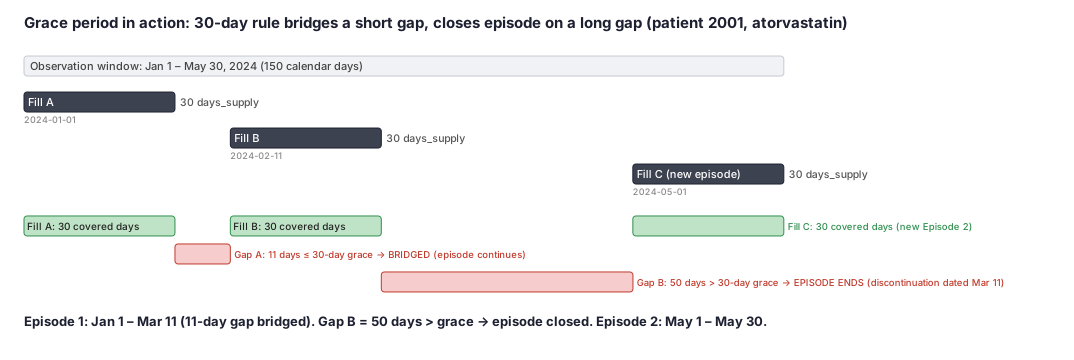
Patient 2001 is prescribed a once-daily cholesterol-lowering tablet. We want to know how long she stayed on the drug during 2024. She fills the prescription three times. Our grace period is 30 days, meaning: if the next fill arrives within 30 days of the previous fill running out, the episode continues; if the gap exceeds 30 days, we record discontinuation at the prior run-out date and the later fill opens a new, separate episode.
Dataset
Raw pharmacy claims rows for patient 2001 — exactly what an analyst would see in a claims database.
| person_id | fill_date | drug | days_supply |
|---|---|---|---|
| 2001 | 2024-01-01 | atorvastatin | 30 |
| 2001 | 2024-02-11 | atorvastatin | 30 |
| 2001 | 2024-05-01 | atorvastatin | 30 |
Steps
Result
- Label
Episode 1: Jan 1 – Mar 11 (71-day span, 60 pill-covered days, 11-day gap bridged). Episode 2: May 1 – May 30 (30-day span). Gap of 50 days between Mar 12 and Apr 30 exceeded the 30-day grace and closed Episode 1.
- Value
- Episode 1 Span Days
71
- Episode 1 Pill Covered Days
60
- Bridged Gap Days
11
- Episode Ending Gap Days
50
- Grace Period Days
30
- Gap A Bridged
True
- Episode 2 Span Days
30
Trade-offs
Runnable example
Build exposure episodes from claims-style pharmacy fills using a grace period with optional stockpiling carry-over. Required input (cleaned, de-duplicated, reversals netted out): rx : person_id, fill_date (datetime64), days_supply (int) # one row per dispensing Returns one row per exposure episode: person_id,...
import pandas as pd

GRACE_DAYS = 30      # permissible gap after run-out before the episode is closed
CARRYOVER_CAP = 30   # max banked surplus from early refills (set 0 to disable stockpiling)

def build_episodes(rx: pd.DataFrame) -> pd.DataFrame:
    rx = rx.sort_values(["person_id", "fill_date"]).copy()
    out = []
    for pid, g in rx.groupby("person_id", sort=False):
        ep_start = run_out = None
        n_fills = 0
        for fd, ds in zip(g["fill_date"], g["days_supply"]):
            if ep_start is None:
                ep_start, run_out, n_fills = fd, fd + pd.Timedelta(days=int(ds)), 1
                continue
            gap = (fd - run_out).days
            if gap <= GRACE_DAYS:
                # continue episode; stockpile early supply forward, capped to bound banking
                surplus = max(0, -gap)
                start = run_out if surplus > 0 else fd
                extra = min(surplus, CARRYOVER_CAP)
                run_out = max(run_out, start) + pd.Timedelta(days=int(ds) - (surplus - extra))
                n_fills += 1
            else:
                out.append((pid, ep_start, run_out, run_out, n_fills))  # discontinuation = run_out
                ep_start, run_out, n_fills = fd, fd + pd.Timedelta(days=int(ds)), 1
        if ep_start is not None:
            out.append((pid, ep_start, run_out, run_out, n_fills))
    return pd.DataFrame(out, columns=["person_id", "episode_start", "run_out",
                                      "discontinuation_date", "n_fills"])
Episode construction with a permissible-gap rule using data.table. Input mirrors the Python version: rx : person_id, fill_date (Date), days_supply (integer) # one row per dispensing, cleaned/de-duplicated Returns one episode per row with discontinuation dated at the last fill's covered run-out.
library(data.table)
GRACE_DAYS <- 30L
CARRYOVER_CAP <- 30L

build_episodes <- function(rx) {
  setDT(rx); setorder(rx, person_id, fill_date)
  rx[, {
    ep_start <- run_out <- NA; nfill <- 0L
    res <- list()
    for (i in seq_len(.N)) {
      fd <- fill_date[i]; ds <- as.integer(days_supply[i])
      if (is.na(ep_start)) { ep_start <- fd; run_out <- fd + ds; nfill <- 1L; next }
      gap <- as.integer(fd - run_out)
      if (gap <= GRACE_DAYS) {
        surplus <- max(0L, -gap)
        start   <- if (surplus > 0L) run_out else fd
        extra   <- min(surplus, CARRYOVER_CAP)
        run_out <- max(run_out, start) + (ds - (surplus - extra))
        nfill   <- nfill + 1L
      } else {
        res[[length(res) + 1L]] <- list(ep_start, run_out, run_out, nfill)
        ep_start <- fd; run_out <- fd + ds; nfill <- 1L
      }
    }
    res[[length(res) + 1L]] <- list(ep_start, run_out, run_out, nfill)
    rbindlist(lapply(res, function(x) data.table(episode_start = x[[1]],
      run_out = x[[2]], discontinuation_date = x[[3]], n_fills = x[[4]])))
  }, by = person_id]
}
Episode construction with a permissible-gap rule in a single sorted data step. Required input (post data-management, de-duplicated, reversals removed): work.rx : person_id, fill_date (SAS date), days_supply (numeric) # one row per dispensing Output work.episodes has one row per episode with discontinuation_date =...
%let grace = 30;   /* permissible gap in days */
%let cap   = 30;   /* max banked surplus from early refills */

proc sort data=work.rx; by person_id fill_date; run;

data work.episodes(keep=person_id episode_start run_out discontinuation_date n_fills);
  set work.rx; by person_id fill_date;
  format episode_start run_out discontinuation_date date9.;
  retain episode_start run_out n_fills;

  if first.person_id then do;
    episode_start = fill_date; run_out = fill_date + days_supply; n_fills = 1;
  end;
  else do;
    gap = fill_date - run_out;
    if gap <= &grace then do;                 /* continue episode */
      surplus = max(0, -gap);
      start   = ifn(surplus > 0, run_out, fill_date);
      extra   = min(surplus, &cap);
      run_out = max(run_out, start) + (days_supply - (surplus - extra));
      n_fills + 1;
    end;
    else do;                                  /* gap exceeds grace: close prior episode */
      discontinuation_date = run_out; output;
      episode_start = fill_date; run_out = fill_date + days_supply; n_fills = 1;
    end;
  end;

  if last.person_id then do;                  /* flush final episode */
    discontinuation_date = run_out; output;
  end;
run;
Citations
- [1]Gardarsdottir H, Souverein PC, Egberts TCG, Heerdink ER. Construction of drug treatment episodes from drug-dispensing histories is influenced by the gap length. Journal of Clinical Epidemiology. 2010;63(4):422-427.
- [2]Cramer JA, Roy A, Burrell A, Fairchild CJ, Fuldeore MJ, Ollendorf DA, Wong PK. Medication compliance and persistence: terminology and definitions. Value in Health. 2008;11(1):44-47.
- [3]Andrade SE, Kahler KH, Frech F, Chan KA. Methods for evaluation of medication adherence and persistence using automated databases. Pharmacoepidemiology and Drug Safety. 2006;15(8):565-574.